HealthcareUX & Product Strategy · Confidential
Healthcare AI App Strategy
How an AI health-screening capability became a clear, viable, and adoptable product direction in a crowded, regulated, trust-sensitive market.
Role
UX researcher & business analyst
Timeline
4 months
Scope
Competitive and market research, regulatory review, UX strategy
Tools
Miro, Figma
80+
Products analyzed
5
Research streams
2
Audience lenses
3
Teams engagement
Challenge
A promising AI screening capability with no clear product direction in a regulated, trust-sensitive market.
What I did
Led and supported a multi-round research and built decision-ready frameworks to identify where the capability could create the most value.
Outcome
A defensible app direction the client committed to and has since moved into development.
01
An early-stage company had built an AI-powered health-screening capability with potential reach across consumer wellness, at-home testing, and clinical diagnostics. The technology was promising, but the product direction was wide open. That turned out not to be a design problem.
The same capability could credibly become several different products. The real challenge was to determine where it could create the most value, and what product model would make that value credible, adoptable, and usable.
The same capability could support six different product directions. The research was organized around six streategic questions to frame the problem:

01
Where should the product play in the care journey?
02
Who is the primary audience?
03
What claims would be credible?
04
Which adoption barriers matter most?
05
What experience patterns are required?
06
How broad could the opportunity become?
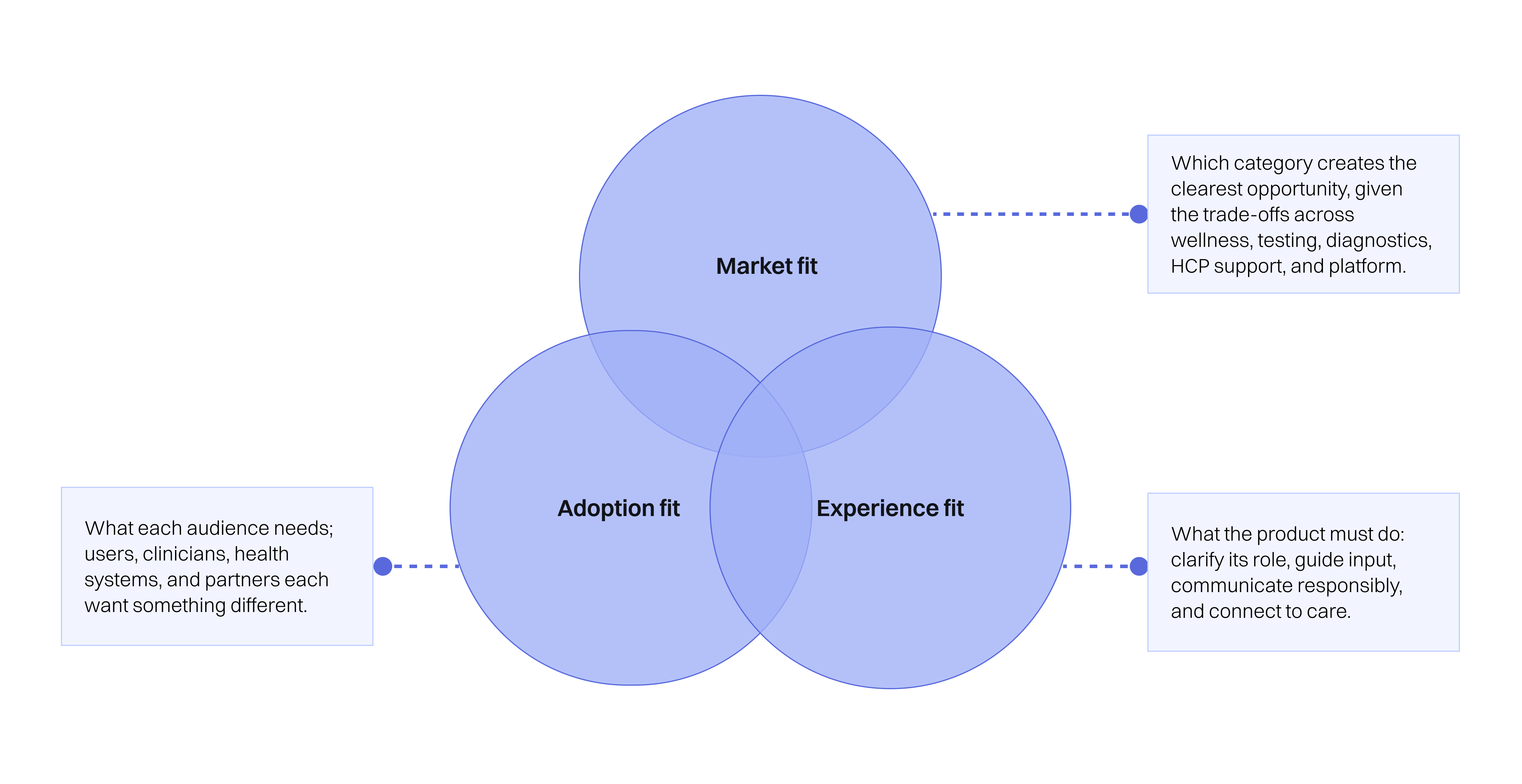
To evaluate these questions consistently, I grouped the opportunity through three lenses: market fit, adoption fit, and experience fit.
The research moved through four stages, from landscape scan to synthesis.
02
Source material ranged from regulatory filings to app-store reviews, so I created a structure for comparing evidence consistently while keeping differences in source confidence visible.
I studied the market through two lenses: direct-to-consumer experiences and clinician-facing tools. Together, they were examined across five connected research streams.

Two lenses, DTC and HCP, studied across five connected research streams.

High
Peer-reviewed research, government publications, regulatory databases, and formal regulatory filings.
Medium confidence
Official company documentation, product pages, press releases, and investor materials.
Contextual evidence
App-store reviews, forums, blogs, and informal commentary which helped identify recurring experience patterns but were not used to support clinical or regulatory claims.
A source-confidence system kept evidence honest
Across the broader research program, I reviewed more than 80 products. The initial landscape scan screened 30+ possible directions before deeper comparative analysis narrowed the field.The research moved through four stages, from landscape scanning to strategic synthesis:
The research moved through four stages, from landscape scan to synthesis.
A directional view of where the market was converging, becoming crowded, or leaving open territory. Placement was informed by publicly available signals related to market presence, investment, partnerships, product maturity, and evidence of adoption.
This is some text inside of a div block.
Regulatory takeaway
This is some text inside of a div block.
Many consumer apps describe themselves as non-diagnostic while also holding medical-device certifications. Regulatory exposure is not determined by marketing language alone. Intended use, functionality, and product claims all influence how a product is classified and evaluated.
03
A consistent set of patterns separated products that appeared credible and adoptable from those that felt unclear, disconnected, or difficult to trust.
These findings were synthesized from secondary research, competitive analysis, product reviews, and regulatory evidence. They represent evidence-based strategic hypotheses rather than findings validated through primary consumer or clinician interviews.
Trust is the gating factor
  • Users need scientific backing, transparent data practices, and clear limits, not simply more features.
  • Guided capture is a core capability because poor input can weaken the experience before the AI produces a result.
  • History and shareable reports turn one-time results into reasons to return.
Adoption depends on workflow fit
  • The strongest tools fit existing workflows through EHR integration and familiar interaction patterns.
  • Skepticism is tied to liability and black-box AI, making explainability and augmentation essential.
  • Anything that influences diagnosis carries a higher standard for evidence and accountability.
Claims are a product-risk decision
  • When a product functions like a medical device, it may be evaluated like one regardless of softer marketing language.
  • The strongest opportunity was not an isolated screening app. It was an app designed as part of a connected model linking guided capture, screening, history, clinicians, and follow-up care.
User journey map, where trust, guidance, and follow-up mattered most.
The connected-experience model: value lives in what happens after the result.
04
Five trade-offs defined the strategy — each with a clear implication.
Strategic tensions, mapped.
05
The research pointed toward a product direction that could sit between consumer access and clinical credibility.

The strongest opportunity was not to position the product as “AI first.” It was to define where the AI belonged in the care journey, what it needed to prove, how users would be guided through the experience, and how the result would connect to follow-up care.

The strongest opportunity was not to make AI the story, but to define where it belongs, what it proves, and how it connects users to care.

I framed the direction as a strategic spine the team could build against:
01
Position
Place the product clearly in the care journey.
02
Prove
Back claims with evidence and validation.
03
Guide
Drive accurate input and understandable output.
04
Connect
Link results to history, clinicians, and care.
05
Scale
Grow from a focused use case to a platform.
06
Five trade-offs shaped the strategy, each with a direct implication for the product.

The research became a product, not just a deliverable.

The conversation before
Can we prove the AI works?
The conversation after
This is some text inside of a div block.
Where does this capability create the most value, and how do we make the app credible, adoptable, and useful within the care journey?
A shared map
The team gained a common view of a noisy market and a shared vocabulary for evaluating product trade-offs.
Decision-ready frameworks
The analytical models gave the team a defensible basis for choosing a direction rather than simply presenting more data.
From exploration to app development
The client committed to a product direction and moved into app development, carrying the positioning, trust, and experience priorities identified through the research into the next phase.
06
This project changed how I think about UX research and product strategy. Product value does not come from the AI alone. It comes from understanding where the technology belongs, who it serves, which decisions it supports, and how responsibly it fits into the care journey.
In healthcare, usability is only one part of the question. A product also has to be understandable, credible, adoptable, and connected to a real care pathway.