From AI Capability to Healthcare App Product Strategy
Healthcare
UX & Product Strategy
Confidential
How an AI health-screening capability became a clear, viable, and adoptable product direction in a crowded, regulated, trust-sensitive market.

80+
Products analyzed
5
Research streams
2
Audience lenses
4 mo
Engagement
Challenge
A promising AI screening capability with no clear product direction in a regulated, trust-sensitive market.
What I did
Ran a multi-round research program and built decision-ready frameworks to map where the capability could win.
Outcome
A defensible product direction the client committed to — and has since moved into building.
01
The challenge
An early-stage company had built an AI-powered health-screening capability with potential reach across consumer wellness, at-home testing, and clinical diagnostics. The technology was promising but the product direction was wide open. And that turned out not to be a design problem.
The same capability could become six different products. The real question was where it creates the most value and what model makes that value credible.
The research was organized around six questions
01
Where should the product play in the care journey?
02
Who is the primary audience?
03
What claims would be credible?
04
Which adoption barriers matter most?
05
What experience patterns are required?
06
How broad could the opportunity become?
02
Approach
Source material ranged from regulatory filings to app-store reviews, so I built a structure that made the analysis rigorous, comparable, and trustworthy.
Two lenses, DTC and clinician tools, studied across five connected research streams.
A source-confidence system kept evidence honest
High
Peer-reviewed research, government and regulatory sources, investor materials.
Medium
Company marketing and product pages.
Low
Blogs, forums, and informal commentary
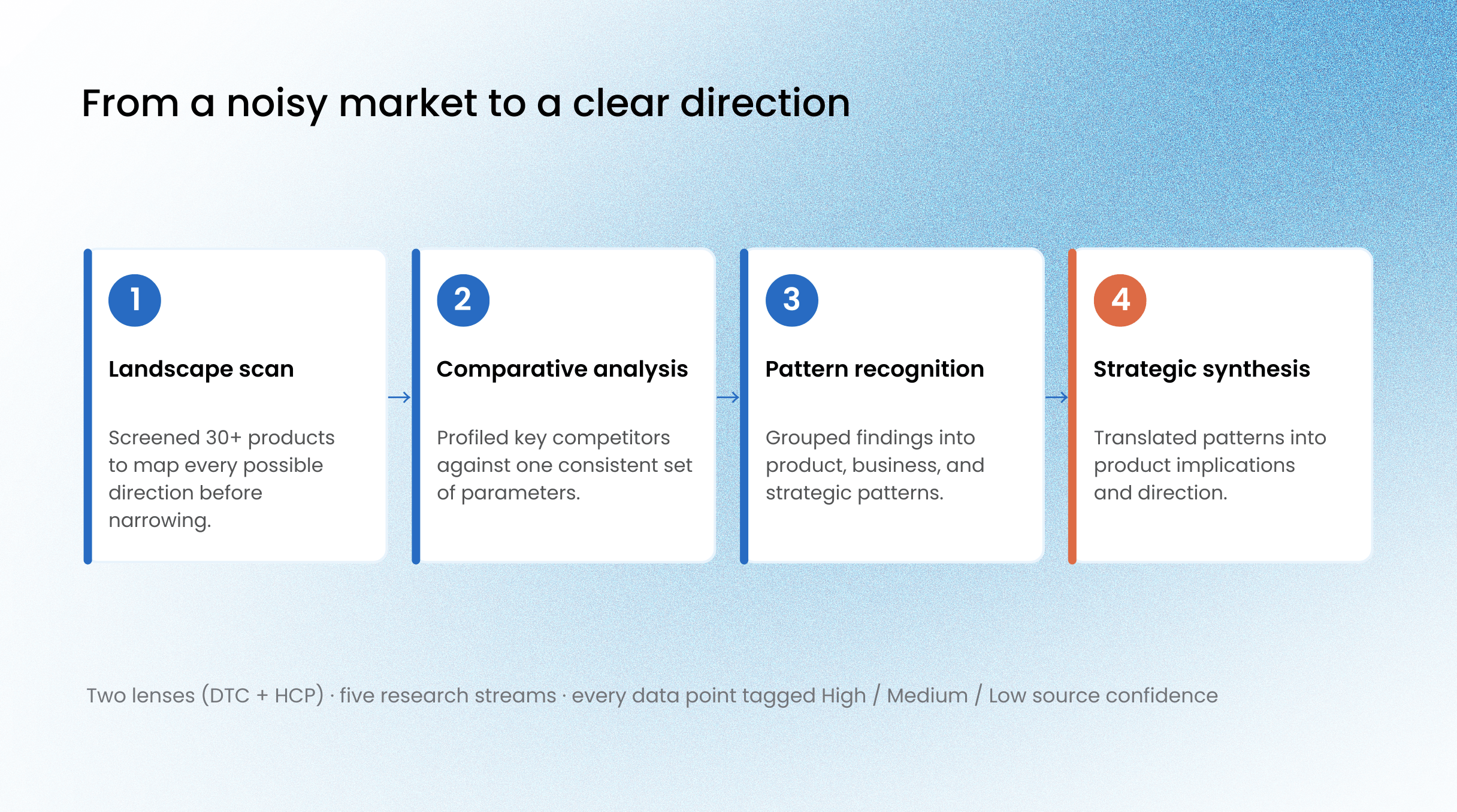
The research moved through four stages, from landscape scan to synthesis.
Rather than a stack of competitor profiles, I built analytical models that made the market legible at a glance — including an Investment × Adoption quadrant that grouped players into Juggernauts, Challengers, Nascent, and “White Elephants” — strong investment signals, weak adoption.
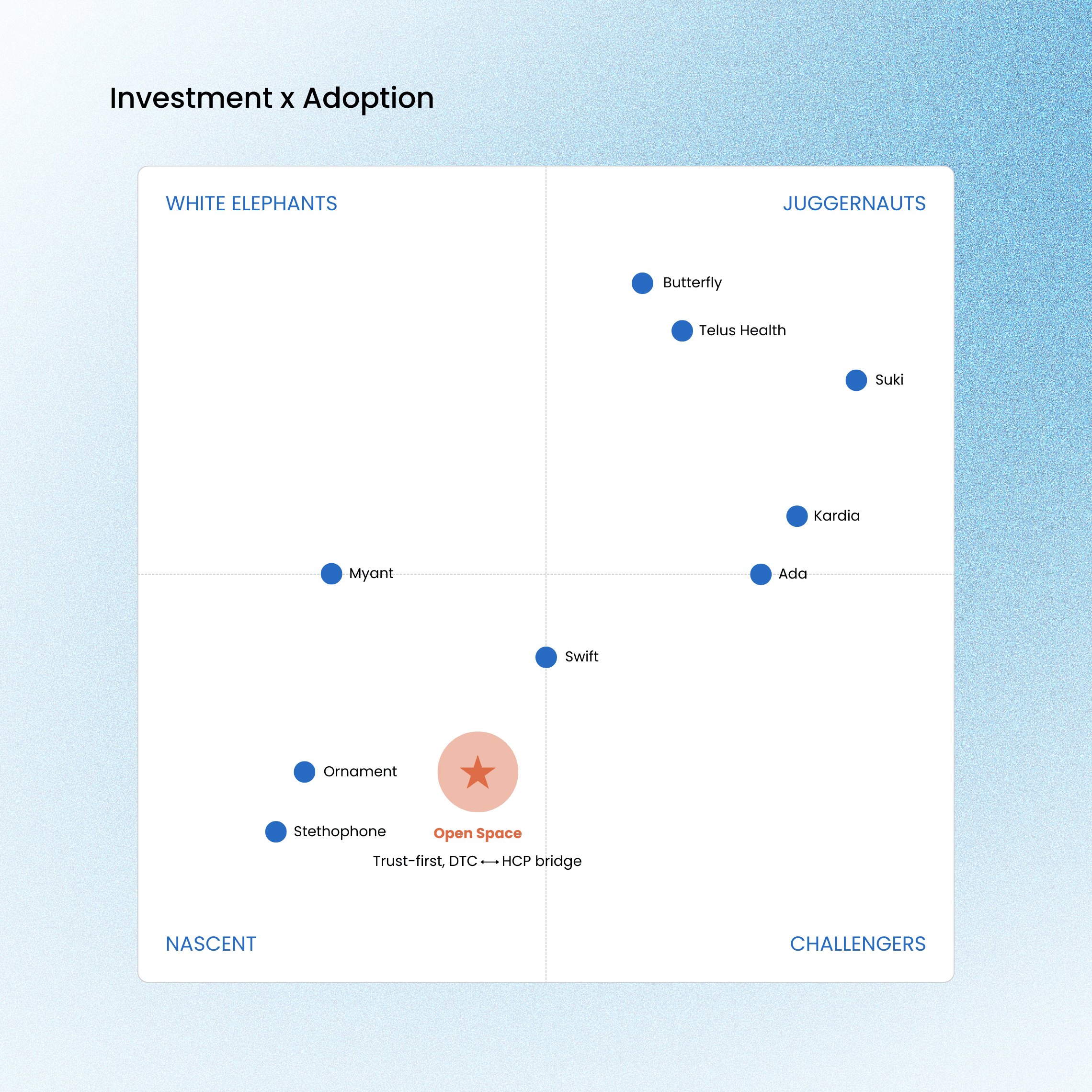
Positioning matrix — where the market was converging, crowding, or leaving open territory.
Regulatory takeaway
Many consumer apps position as “non-diagnostic” while still holding medical-device certifications. Regulatory exposure isn’t set by marketing language — intended use, functionality, and claims all shape how a product is judged.
03
What the research found
A consistent set of patterns separated products that felt credible and adoptable from those that felt unclear or hard to trust.
Consumer side
Trust is the gating factor
- Users need scientific backing, transparent data practices, and clear limits — not more features.
- Guided capture is a core capability: bad input breaks the experience before the AI even runs.
- History and shareable reports turn one-time results into reasons to return.
Clinician side
Adoption depends on workflow fit
- The strongest tools fit existing workflows — EHR sync, familiar patterns.
- Skepticism ties to liability and black-box AI, so explainability and augmentation are essential.
- Anything influencing diagnosis carries a higher bar for evidence and accountability.
Across both
Claims are a product-risk decision
- If a product behaves like a medical device, it gets judged like one — regardless of softer marketing.
- The strongest opportunity wasn’t a standalone app, but a connected model linking capture, screening, history, and care.
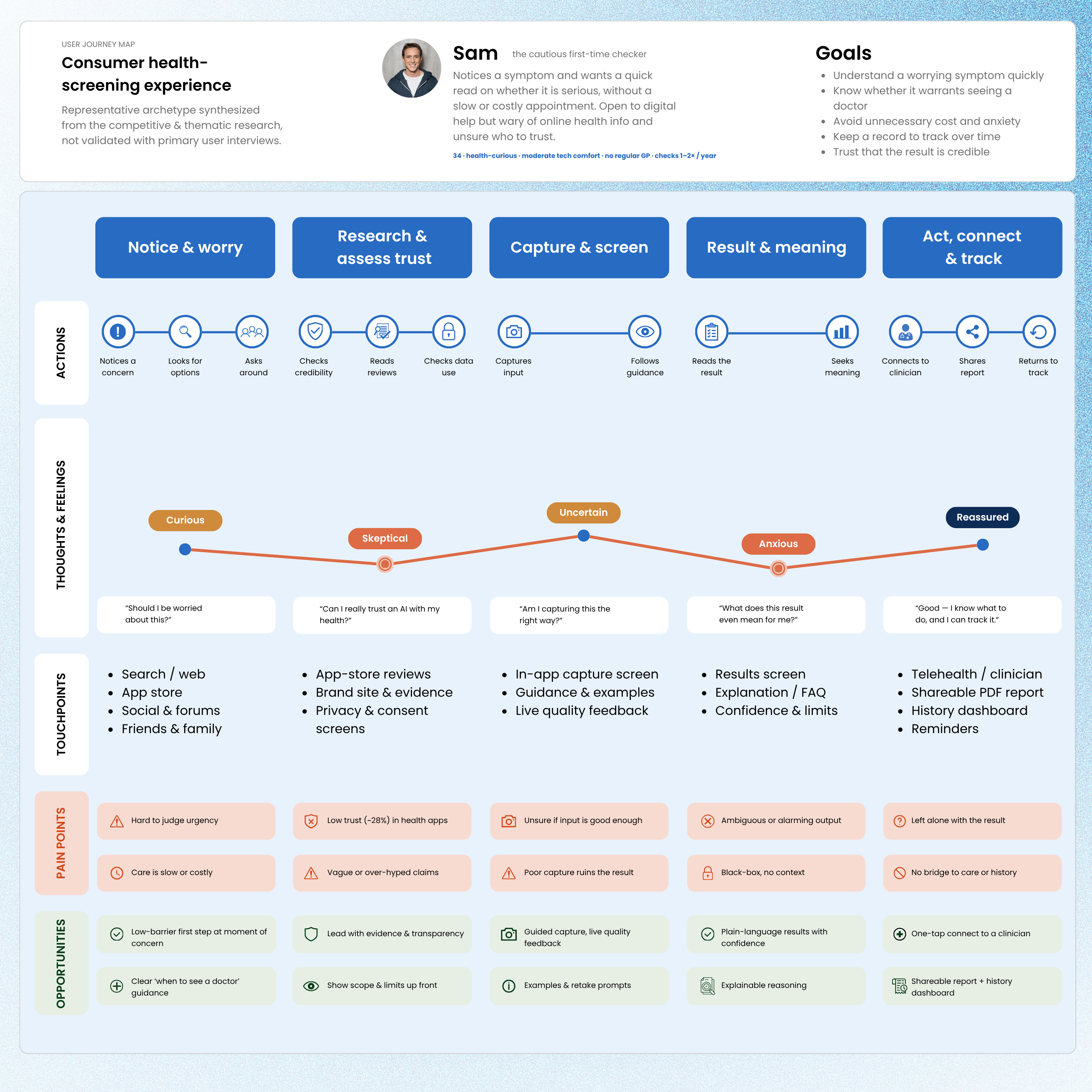
User journey map, where trust, guidance, and follow-up mattered most.
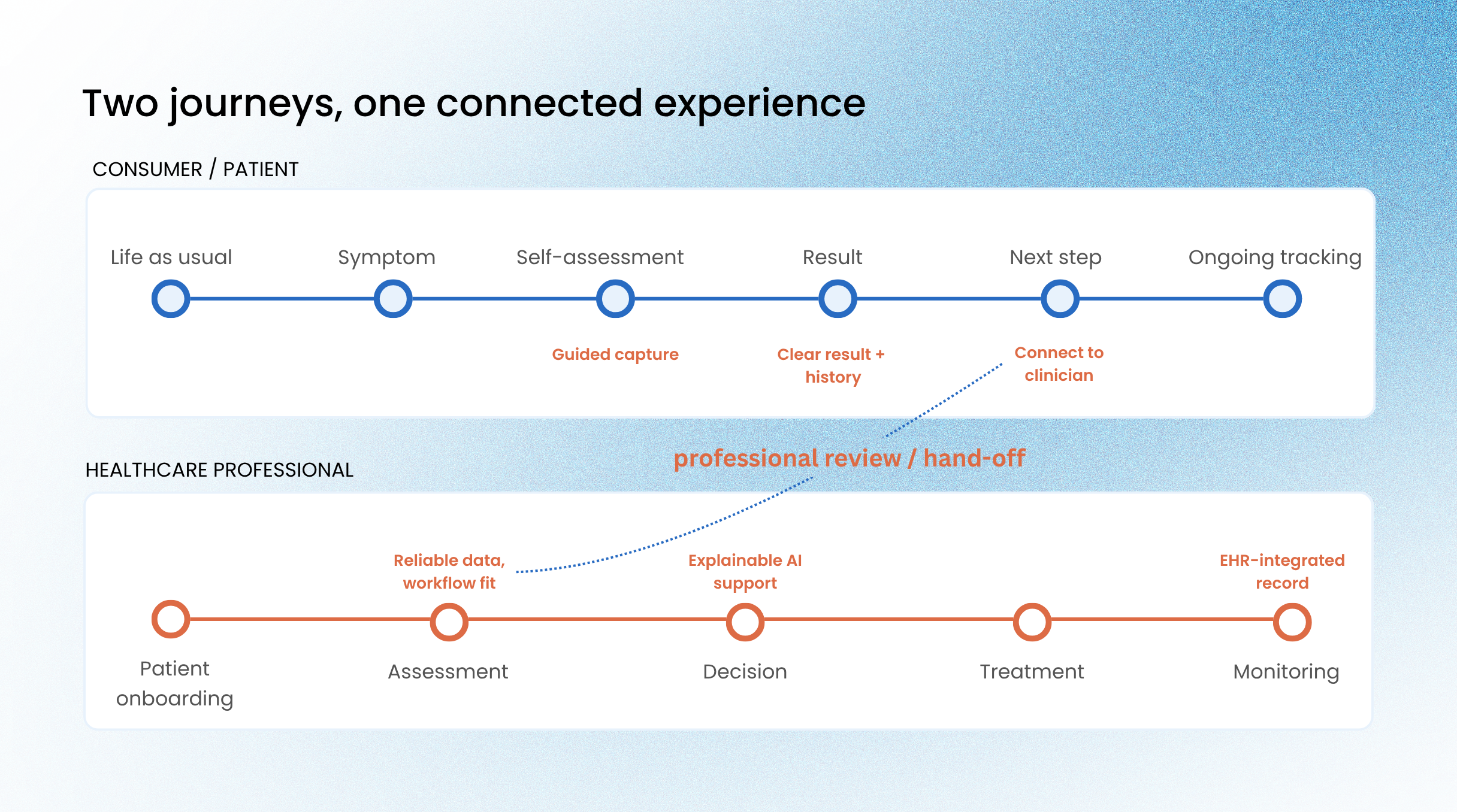
The connected-experience model: value lives in what happens after the result.
04
The tensions that shaped direction
Five trade-offs defined the strategy — each with a clear implication.
DTC reach
vs
Clinical credibility
Speak to both audiences — differently.
Wellness positioning
vs
Diagnostic value
Claims must match actual functionality.
AI innovation
vs
Healthcare usefulness
Lead with practical value, not “advanced AI.”
Standalone app
vs
Connected ecosystem
Value lives in what happens after the result.
Speed
vs
Responsibility
Fast results only help when users know what’s next.
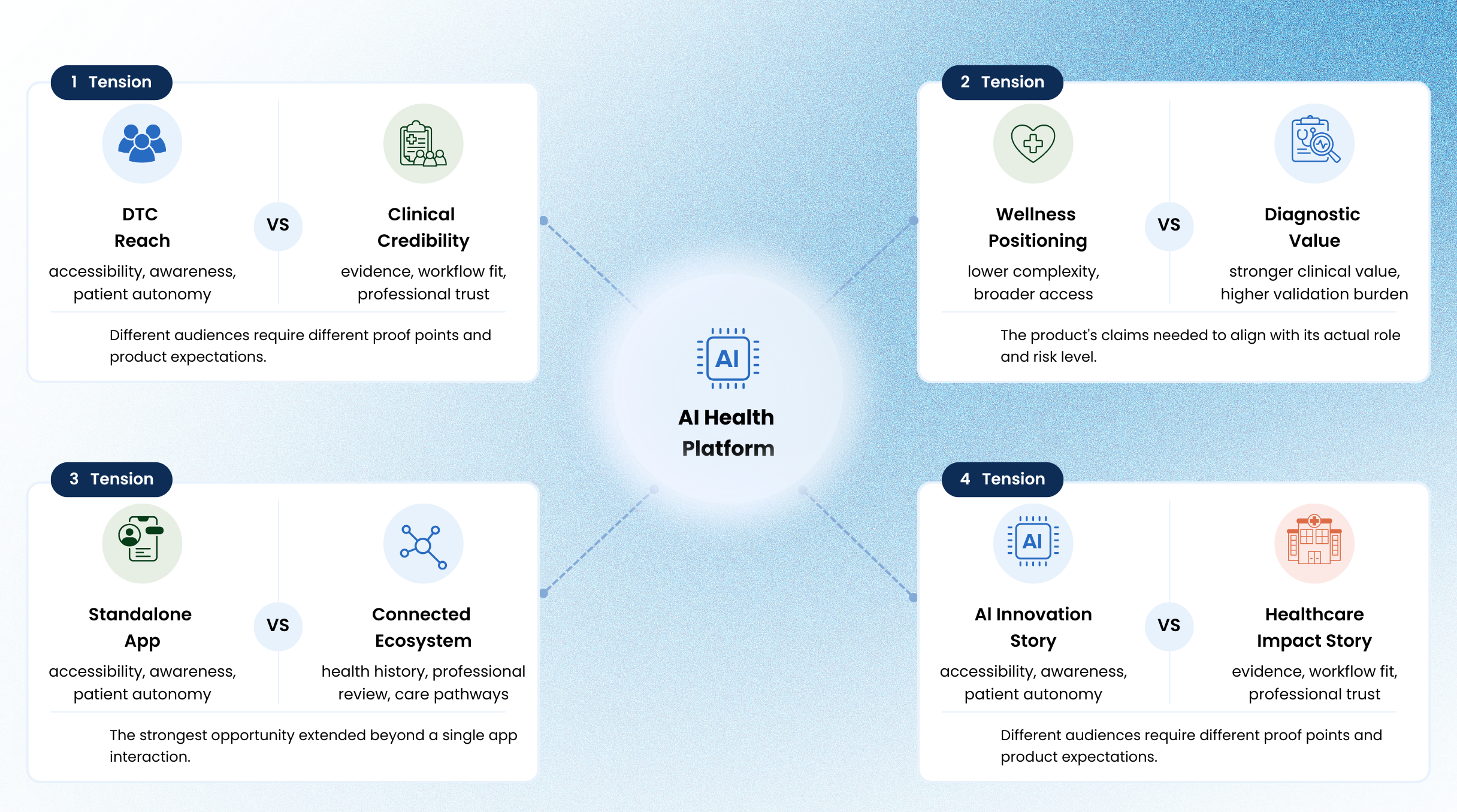
Strategic tensions, mapped.
05
Synthesis & direction
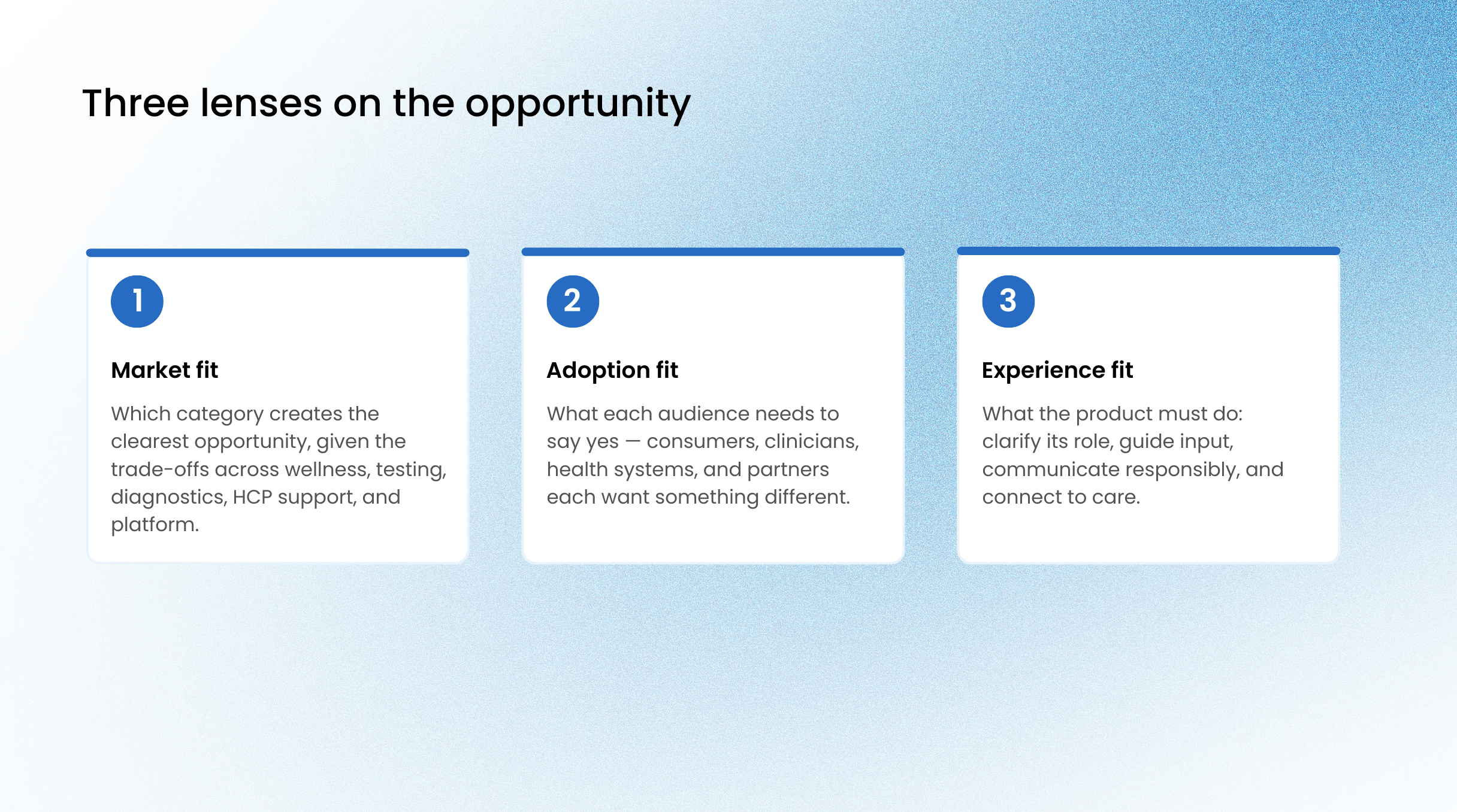
Three lenses pointed toward one direction: accessible enough for self-directed users, credible enough for professional adoption, and defined by the healthcare problem it solves — not the AI underneath it.
Three lenses, each answering a different question about where the capability could win.
I framed the direction as a spine the team could build against
01
Position
Place the product clearly in the care journey.
02
Prove
Back claims with evidence and validation.
03
Guide
Drive accurate input and understandable output.
04
Connect
Link results to history, clinicians, and care.
05
Scale
Grow from a focused use case to a platform.
06
Outcome
The research became a
decision — not a
deliverable.
decision — not a
deliverable.
The conversation before
Can we prove the AI works?
→
The conversation after
Where does this create the most value, and how do we make it credible and adoptable?
A shared map
The team gained a common picture of a noisy market and a vocabulary for weighing trade-offs.
Decision-ready frameworks
The analytical models gave the team a defensible basis for choosing a direction, not just data.
From exploration to build
The client committed to a direction and has since moved into developing the product — carrying the positioning and experience priorities forward.
07
Reflection
This project changed how I see UX and CX research. Product value doesn’t come from the AI; it comes from knowing where the technology belongs, who it serves, what decisions it supports, and how responsibly it fits into the care journey. In healthcare, usability is only one part of the question; a product also has to be understandable, credible, adoptable, and connected to a real care pathway.